
When you need a secure way to make a payment without using cash or personal checks, money orders and cashier’s checks are two common options. The best choice depends on the amount you need to pay, where you can get the payment method, and the fees involved.
Understanding how each works helps you dodge problems like bounced checks or unnecessary costs.
Money orders are usually for smaller payments and you can buy them at many stores or post offices, even if you don’t have a bank account. Cashier’s checks come from banks and are meant for bigger, more important purchases where sellers want extra security.
Knowing when to use each can save you time and money. You’ll also want to consider where you can buy these and what they cost.
This guide will give you clear advice on how to choose the right option for your next payment.
Key Takeways
- Money orders work best for smaller payments and are easy to find almost anywhere.
- Cashier’s checks are for larger payments and you have to buy them at a bank.
- Fees and purchase requirements aren’t the same for money orders and cashier’s checks.
Understanding Money Orders and Cashier’s Checks
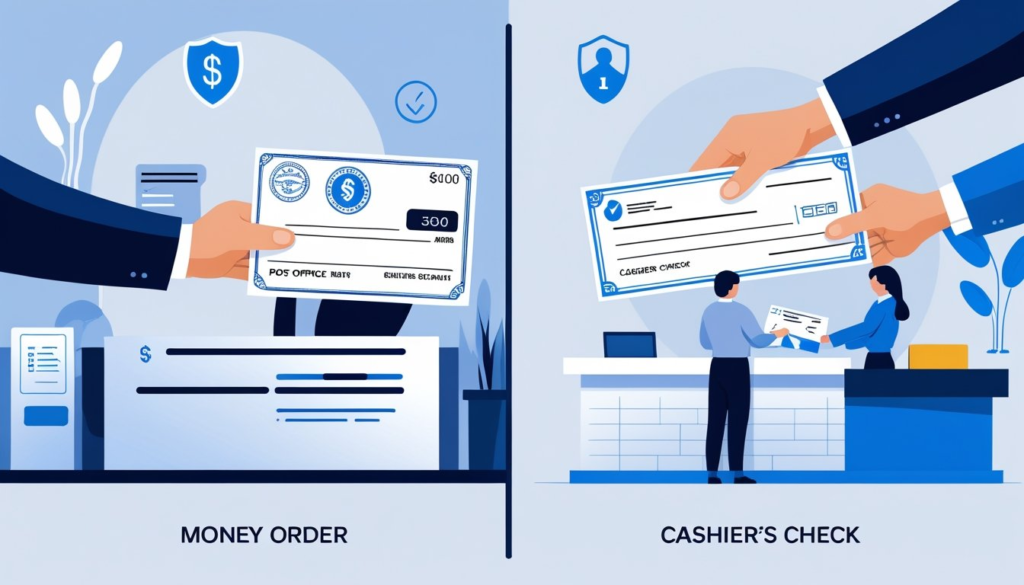
You have options when paying securely without using cash or personal checks. Each offers a different guarantee and comes from a different source.
Knowing these differences helps you pick what fits your needs.
What Is a Money Order?
A money order is prepaid. You buy it at banks, credit unions, post offices, or some stores.
You pay the full amount upfront, so the money is guaranteed when the recipient cashes or deposits it. Money orders usually have a limit of around $1,000 per order.
They show the recipient’s name, your details, and a tracking number. This adds a layer of security by tying the payment to specific people.
You pay a small fee, often under $5. Money orders suit smaller transactions or when you want to avoid sharing your bank info.
People often use them for rent, court fees, or sending money abroad.
What Is a Cashier’s Check?
A cashier’s check is a secure payment tool you get directly from a bank or credit union. The bank guarantees the payment by withdrawing funds from your account before issuing the check.
These checks are for bigger purchases, like a car or a house down payment. They usually cost more—think $5 to $15.
Cashier’s checks have advanced security features like watermarks and special paper to help prevent fraud. Because the bank stands behind the funds, sellers trust them for high-value deals.
You need to visit the bank to get one and provide the recipient’s name and the exact amount.
How They Differ from Personal Checks
Personal checks pull money from your bank account when someone deposits or cashes them. If you don’t have enough in your account, the check can bounce.
Money orders and cashier’s checks, on the other hand, give prepaid or guaranteed funds. Money orders ask for payment upfront, while cashier’s checks are backed by the bank.
With personal checks, your account and routing numbers show up on the check. Money orders and cashier’s checks hide this info, which helps protect you from fraud.
Both create a level of trust that personal checks often don’t, especially with strangers or larger amounts.
Key Differences Between Money Orders and Cashier’s Checks
Money orders and cashier’s checks both work as secure payment methods, but they aren’t the same. They differ in limits, guarantees, and where you can get them.
Purchase Limits and Typical Use Cases
Money orders usually cap out at $1,000 per order. That makes them good for smaller stuff, like paying bills or sending money without a bank account.
Cashier’s checks, though, let you pay much larger amounts. People use them for big buys—houses, cars, that sort of thing.
If you need to send a big sum, go with a cashier’s check. For smaller or mid-sized payments, money orders are often easier and accepted in more places.
Payment Security and Guarantees
Banks and credit unions issue and guarantee cashier’s checks. The funds are secured and backed by the bank, so people trust them for big payments.
Money orders are prepaid and you can buy them at post offices, grocery stores, and convenience stores. They’re generally secure, but since they’re not always bank-backed, some sellers may trust them less.
Neither reveals your bank account info, which is a plus. Still, watch out for scams—fake money orders and cashier’s checks do exist.
Where to Obtain Each Option
You can buy money orders at the U.S. Post Office, grocery stores, convenience stores, and some retail stores. Most places don’t require a bank account.
Cashier’s checks are only at banks and credit unions. You usually need an account, though a few banks might let you buy one with cash or a debit card—depends on the place.
If you don’t have a local bank account, getting a cashier’s check isn’t always easy. Money orders are just more flexible and available on short notice.
Costs and Fees
Money orders and cashier’s checks both come with fees, but the amounts can vary a lot depending on where you buy them. Money orders usually cost less, while cashier’s checks tend to have higher, more set fees.
Money Order Fees by Location
Money order fees are usually low, but they do change depending on where you go.
- Post offices charge about $1 to $2.
- Walmart and grocery stores often charge $0.35 to $1.50.
- Banks and credit unions might go as high as $5.
- You don’t need a bank account to buy a money order, which is handy.
If you’re sending money internationally, expect extra fees that vary by location and carrier. Usually, you pay with cash or debit—credit cards are rarely accepted for money orders.
Cashier’s Check Fee Structures
Cashier’s checks almost always cost more than money orders. Most banks charge about $6 to $15, with $10 being pretty common.
- You’ll pay this whether you get the check at a branch or online.
- Some banks tack on shipping charges for online orders. For example, Wells Fargo adds $8 to its $10 base fee if you want it shipped.
- You usually need a bank account and ID to buy a cashier’s check.
- Fees can change a bit based on the bank or your account type.
People use cashier’s checks for large payments, so the higher fee covers the added security.
When to Use a Money Order
Money orders come in handy when you want a secure, prepaid way to pay, especially for smaller amounts. They’re easy to find and work well if you don’t have a bank account or don’t want to share your banking info.
Ideal Transaction Sizes
Money orders work best for anything under $1,000. If you need to send money, pay rent, or cover bills in this range, a money order does the trick.
Many places set this limit to cut down on risk and fraud. Use money orders for everyday stuff—utility bills, rent, or smaller payments.
They guarantee payment, so you don’t have to worry about bouncing checks or empty accounts.
Accessibility Without a Bank Account
You can buy money orders at tons of places—grocery stores, post offices, retail shops, and convenience stores. No bank account needed.
Just bring cash or a debit card to pay upfront. It’s a solid choice if you want a paper payment or can’t use digital payments for whatever reason.
Limitations and Risks
Money orders have a cap, usually $1,000. For bigger payments, you’d need to buy several, which can be a hassle.
Security features are basic, so scams and fraud do happen. Keep your receipt as proof and don’t send money orders to people you don’t know—it’s just not worth the risk.
When to Use a Cashier’s Check
Cashier’s checks are for times when you need a secure, guaranteed payment. They’re ideal when the seller wants proof of funds or you want to avoid the risk of a bounced check.
You’ll run into cashier’s checks with high amounts or strict payment rules.
Large Purchases and Transactions
Cashier’s checks shine for large purchases, usually over $1,000. Think buying a car, putting down an apartment deposit, or making a house down payment.
The bank pulls the money straight from your account when you request the check. Most banks set high or no upper limits, so you can safely pay big amounts without lugging around cash.
Preferred Situations for Guaranteed Funds
Use a cashier’s check when you need guaranteed funds. Some sellers or landlords refuse personal checks because they can bounce—cashier’s checks take that risk off the table.
They’re also helpful in business deals or when you’re paying someone you don’t know. The recipient can cash the check right away, or at least by the next business day.
Common Issues and Considerations
Before you get a cashier’s check, know a few things. You typically need to be a customer at the issuing bank—most won’t sell you one if you don’t have an account.
Fees range from $6 to $15. If you order online, some banks charge extra for delivery.
Always double-check the payee’s name and the amount. Once issued, you can’t cancel a cashier’s check without the bank’s approval, unlike certified checks.
Choosing the Right Secure Payment Method
When you’re deciding between payment methods, think about what you need: the amount, how you’ll access your funds, and how fast the payment has to clear. Understanding how each tool works helps you avoid delays or surprise fees.
Factors to Consider for Your Situation
Think about the payment amount first. If you need to pay more than $1,000, a cashier’s check is usually your best bet.
Banks back cashier’s checks, so they’re safer for big purchases like cars or homes. You’ll usually need to be a customer, and banks charge somewhere between $6 and $15 for them.
For smaller payments, or if you don’t have a bank account, a money order can work just fine. You can pick these up at post offices, grocery stores, or similar spots.
Money orders cost about $1 to $5 and usually top out at $1,000 each. Timing matters, too.
Cashier’s checks often clear faster than money orders. Think about how much control and security you want, and whether the person you’re paying will even take these forms.
Comparing Alternatives Like Certified Checks and Peer-to-Peer Apps
A certified check is another secure option. It’s a personal check your bank guarantees, so it offers similar protection to a cashier’s check, but it’s not as common and sometimes takes longer to process.
If you have a bank account and a smartphone, peer-to-peer apps like Venmo can be super convenient for quick transfers. These work best for people you trust and smaller amounts.
Venmo and similar apps aren’t great for large payments, or if the seller wants a guaranteed payment method. Here’s a quick comparison:
| Payment Method | Max Amount | Where to Get | Security | Best Use Case |
|---|---|---|---|---|
| Cashier’s Check | Often $1,000+ | Banks, Credit Unions | Bank guaranteed | Large purchases, high trust |
| Money Order | Usually $1,000 | Post Office, Retailers | Prepaid, not bank guaranteed | Small payments, no bank accts |
| Certified Check | Varies | Banks | Bank guaranteed | Medium to large payments |
| Venmo (P2P app) | Varies | Mobile app with bank account | Depends on user trust | Small, personal payments |
Frequently Asked Questions
Here are some common questions about money orders, cashier’s checks, and how they stack up for security, fees, and speed. You’ll also see where to get them and what banks usually expect.
What are the relative security features of a money order versus a cashier’s check?
Cashier’s checks tend to be more secure. Banks back them, and they usually come with watermarks, security threads, or special ink.
Money orders have fewer security features, so they’re a bit easier to forge. Still, both types can attract scams, so it’s smart to double-check any payment you get.
What is the maximum dollar limit for issuing a cashier’s check?
Most banks let you get cashier’s checks for thousands or even tens of thousands of dollars. Money orders usually max out at $1,000.
It’s worth checking with your bank for their exact limits.
Where can one typically obtain a cashier’s check?
You can walk into most banks or credit unions and get a cashier’s check. They’ll issue it to you in person.
Some banks want you to have an account with them first, though.
What are the usual fees associated with acquiring a cashier’s check?
Banks usually charge $5 to $15 for a cashier’s check. The fee can change depending on the bank or your account type.
Money orders are often cheaper—usually under $5.
Is it possible to purchase a cashier’s check from a bank where I don’t hold an account?
Sometimes, yes. A few banks will sell cashier’s checks to non-customers, but they might charge more.
It’s a good idea to call ahead and ask about their policy before you go.
How do the processing times compare between money orders and cashier’s checks?
Cashier’s checks usually clear pretty quickly, sometimes the very same day. That’s because the bank stands behind the funds, so there’s not much waiting around.
Money orders can drag out a bit longer. Processing time depends on where you bought it and how the receiving bank handles things, which can honestly be a little unpredictable.