
When you start investing, picking between index funds and ETFs can feel overwhelming. Both let you invest in lots of companies at once, with low costs and decent diversification.
The best choice really depends on how you want to trade, your budget, and whether you prefer a hands-off or flexible approach.
ETFs trade like stocks during market hours, so you can buy or sell whenever the market’s open. Index funds only trade once a day at a set price, which can be simpler if you’d rather not watch the market all day.
ETFs usually let you start with just one share, making them easier if you don’t have a lot to invest.
Understanding costs, tax effects, and how automatic investing works will help you pick what fits your style.
Key Takeways
- You can trade ETFs anytime, but index funds only once daily.
- ETFs usually have lower starting costs and more flexibility.
- Index funds offer easy automation and simpler tax handling for beginners.
Index Funds vs. ETFs: The Essentials
Both index funds and ETFs let you invest in a group of stocks or bonds that follow a market index. They keep costs low and make it easy to diversify, but there are some differences in how they work and how you buy them.
What Is an Index Fund?
An index fund is a type of mutual fund that tries to match the performance of a specific market index, like the S&P 500. When you put money into an index fund, it’s pooled with other investors to buy all or most of the stocks in that index.
You buy and sell index funds through the mutual fund company, and trades happen only once a day after the market closes. Index funds usually have low fees because they’re passively managed—they just track the market, not try to beat it.
Most index funds have minimum investment amounts. They make it pretty straightforward to grow your money over time by tracking broad market performance.
What Is an ETF?
An ETF, or exchange-traded fund, is a lot like an index fund—it also tracks a market index. The difference is, ETFs trade like stocks on an exchange, so you can buy or sell shares whenever the market’s open.
ETFs usually have low expense ratios, and you can start with just one share. They’re flexible since you can trade throughout the day and use things like stop or limit orders.
Because ETFs trade like stocks, you might pay commission fees or deal with bid-ask spreads. But these days, a lot of brokers offer commission-free ETF trades.
Key Similarities
Both index funds and ETFs aim to track market indexes, giving you exposure to lots of stocks or bonds with one investment. They’re low-cost, passively managed, and help reduce risk by spreading your money across many assets.
You get professional management without the high fees or the stress of active trading. Both options work well for long-term investors looking for steady growth.
| Feature | Index Fund | ETF |
|---|---|---|
| Trades | Once daily at market close | Throughout trading day |
| Purchase Method | Through mutual fund company | On stock exchange |
| Minimum Investment | Often has minimums | Usually buy one share or more |
| Fees | Low expense ratios | Low expense ratios, possible trading fees |
How They Work: Structure and Pricing Differences

Getting how index funds and ETFs operate helps you figure out which one fits your investing style. Their structure changes when and how you buy or sell shares, how prices are set, and what it costs to trade.
Trading Mechanics
When you buy or sell shares of an index mutual fund, it only happens once per trading day. That’s after the market closes, and all orders get priced at the fund’s net asset value (NAV).
You buy or redeem shares directly through the fund company, not on an exchange. ETFs do it differently—they’re listed on stock exchanges and bought or sold like regular stocks.
You can trade ETFs at any time during the trading day. This gives you more flexibility and control over when you buy or sell.
Net Asset Value and Market Price
The net asset value (NAV) equals the value of all the fund’s holdings divided by the number of shares. For index funds, the NAV is the official price you pay or get when you buy or sell, set at the end of the trading day.
For ETFs, shares have a market price that moves up and down all day. This price is usually close to the NAV but can be higher or lower depending on supply and demand on the exchange.
That can affect how much you pay or receive right away.
Bid-Ask Spread
The bid-ask spread is the gap between the highest price a buyer will pay (bid) and the lowest price a seller wants (ask). ETFs have this spread because they trade on exchanges all day.
If the spread is narrow, your trading costs stay low. Wider spreads mean you pay more. Index mutual funds don’t have a bid-ask spread since trades happen at the NAV price once daily, so you avoid that cost but lose some trading flexibility.
Costs and Fees: What Beginners Should Know
When you’re starting out, understanding the costs is important. You’ll see different fees depending on whether you go with index funds or ETFs.
These fees eat into your returns, so it’s worth knowing how they work.
Expense Ratios
Expense ratios are yearly fees that fund companies charge for managing your investment. They cover operating costs and show up as a percentage of your total investment.
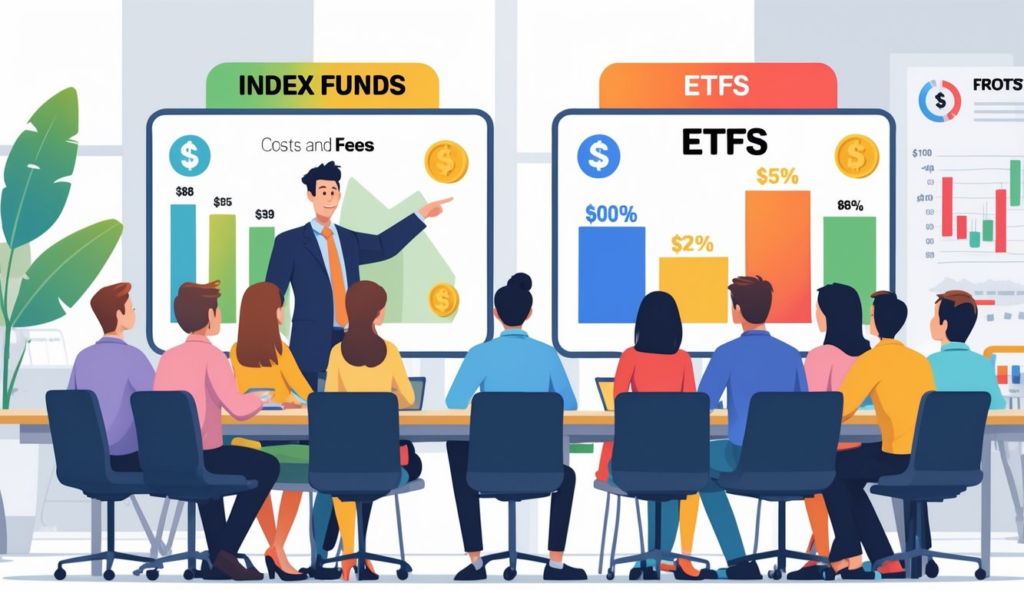
ETFs usually have lower expense ratios, often between 0.03% and 0.10%. Index mutual funds might be a bit higher, sometimes around 0.05% to 0.20%.
Lower expense ratios mean you keep more of your returns over time. Even small differences add up, so look for funds with expense ratios under 0.10% if you want to keep costs down.
Trading Commissions and Fees
How you buy and sell matters too. ETFs trade on stock exchanges like stocks, and your broker might charge trading commissions.
Many brokers now offer commission-free ETF trades, which helps a lot. If your broker does charge commissions, those fees can pile up if you trade a lot.
Index mutual funds usually skip trading commissions when you buy or sell directly through the fund company. But some have sales loads or redemption fees, so check the details.
Always check your brokerage’s fee schedule so you don’t get surprised by extra costs.
Minimum Investment Requirements
Minimum investments are the lowest amount you need to start. Index mutual funds often require more upfront—sometimes $500, $1,000, or even $3,000.
ETFs are more accessible since you can usually buy just one share, and some brokers offer fractional shares. That makes it easier if you’re working with a smaller budget.
If you’re just getting started and don’t have much to invest, ETFs might be the easier entry point.
Access, Flexibility, and Automation

How easy is it to buy and sell shares? Can you automate your investments? These things affect how often you trade, what it costs, and how hands-on you want to be.
Ease of Buying and Selling
With ETFs, you can buy or sell shares at any time during the trading day through your brokerage account. You can react quickly to market changes, and prices move all day.
Some brokers might still charge commissions or small fees for ETF trades, though. Index funds are different—you buy or sell only once daily after the market closes.
You can place orders anytime, but trades settle at the day’s closing price. There’s less flexibility, but usually no trading commissions. Some index funds have minimum investment amounts, which could limit your choices.
Automatic Investing and Dollar-Cost Averaging
Index funds often let you set up automatic investing, so money goes in on a regular schedule. This helps you use dollar-cost averaging—buying at different prices over time, which can smooth out the bumps.
ETFs don’t usually support automatic investing. You have to buy shares manually every time, which isn’t as convenient.
If automation matters to you, index funds might be the way to go. Many brokerages make it easy to set up recurring investments in index funds, so you don’t have to think about it.
Tax Efficiency: Considering Account Types
Taxes can eat into your returns if you’re not careful. Different fund structures handle taxes differently, and where you keep your investments makes a big difference in what you owe each year.
Tax Benefits of ETFs vs. Index Funds
ETFs usually offer better tax efficiency than traditional index mutual funds. That’s because of the way ETFs handle capital gains when investors buy or sell shares.
ETFs use “in-kind redemptions,” which means they swap securities directly instead of selling them. This helps avoid triggering capital gains taxes.
Index mutual funds often have to sell securities to pay investors who cash out, which can create taxable capital gains for everyone in the fund.
Lower turnover in an ETF or index fund generally means fewer capital gains distributions. ETFs tend to manage this more efficiently, so you’re less likely to get hit with big taxable gains compared to mutual funds.
Impact in Taxable and Tax-Advantaged Accounts
If you keep investments in taxable accounts, ETFs usually pass on fewer capital gains than index mutual funds. That means you’ll probably owe less tax each year, which helps your after-tax returns.
In tax-advantaged accounts like a Roth IRA or traditional retirement account, you don’t pay taxes on dividends or capital gains while your money grows. So, tax efficiency isn’t as big a deal if you’re investing inside these accounts.
For taxable accounts, leaning toward ETFs can cut down on tax drag. But for retirement accounts, you can focus more on fees or trading flexibility instead of taxes.
Which Is Better for Beginner Investors?
Choosing between index funds and ETFs really comes down to how much you want to invest, your long-term plans, and which providers you trust. Both types can help you build a solid, diversified portfolio.
Factors to Consider for New Investors
When you start investing, costs and ease of use really matter. Index funds usually let you set up automatic monthly contributions, so you stick to a regular plan without much hassle.
They often have minimum initial investments—sometimes $500 to $3,000—which can be higher than what you’d need for some ETFs.
ETFs trade like stocks all day long. You can buy or sell whenever the market’s open, which gives you flexibility, but you have to make those purchases yourself.
ETF shares can be pretty affordable, sometimes just $10 or so per share, so you don’t need a lot to get started.
Both options have low fees compared to most actively managed funds. Watch out for trading commissions with ETFs, though—it depends on your brokerage.
Tax efficiency matters too, especially if you’re using a taxable account.
Long-Term Growth and Investment Goals
If you’re focused on long-term growth, like retirement or building wealth, index funds can be a solid choice. They’re simple and support automatic contributions, which helps with dollar-cost averaging.
This basically means you buy more shares when prices dip and fewer when they’re high, which can help smooth things out over time.
Index funds often work best for folks who want to “set it and forget it.” Many workplace retirement plans, like 401(k)s, offer index mutual funds because they’re stable and have low fees.
ETFs can also work for long-term growth, especially if you want more control over buying and selling or want to branch out into specific sectors or bonds.
In retirement accounts, where taxes don’t matter as much, both index funds and ETFs make sense.
Popular Providers for Beginners
Some fund providers stand out for beginners. Vanguard and Fidelity are two names you’ll hear a lot.
Vanguard’s known for low-cost index mutual funds and ETFs with some of the lowest expenses out there.
Fidelity also offers index funds and ETFs, and a lot of their funds have no minimum investment, which is great if you’re just starting.
Both let you invest in a wide range of stocks and bonds, so you can easily diversify.
Many providers support workplace retirement plans, which means you might already have access through your employer’s 401(k). Look for funds with low fees and a solid track record from companies you feel good about.
Frequently Asked Questions
Here’s a quick rundown: you’ll see how ETFs and index funds differ in trading and costs, how index funds relate to mutual funds, and how to compare specific fund examples from the same provider. We’ll also cover the ups and downs of ETFs for beginners, and share a bit of Warren Buffett’s advice on index funds.
What are the main differences between ETFs and index funds for long-term investments?
ETFs trade like stocks all day, with prices that move up and down. Index funds only trade once per day, at the market’s closing price.
ETFs usually have lower fees and handle taxes better because of how they’re set up. Index funds might have minimum investments, but you can buy just one share of an ETF.
How do index funds compare to mutual funds for beginner investors?
Index funds are just mutual funds that track an index. They’re usually cheaper than actively managed mutual funds since they don’t try to beat the market.
Actively managed funds often have higher fees and more frequent trading. Index funds give you returns that closely match the index they follow.
Can you explain the difference between an S&P 500 ETF and an S&P 500 index fund?
Both track the S&P 500, which covers large U.S. companies. The big difference is the ETF trades on the stock market all day.
Index fund prices update once after the market closes. ETFs often have slightly lower fees and better tax efficiency.
For a beginner investor, which is preferable: a Vanguard ETF or a Vanguard index fund?
It depends on how you want to invest. If you want to trade during the day, go with a Vanguard ETF.
If you’d rather set up automatic investments with fixed amounts and get end-of-day pricing, a Vanguard index fund is probably better. Both choices offer low fees and broad diversification.
What are the pros and cons of ETFs for first-time investors?
Pros: lower costs, good tax efficiency, and you can trade anytime the market’s open. You can start with just one share.
Cons: you might pay trading fees, and you’ll need to keep an eye on prices, which isn’t for everyone.
What guidance does Warren Buffett provide regarding investing in index funds for new investors?
Buffett tells most people to go for low-cost S&P 500 index funds. He likes how these funds give you broad market exposure without much hassle or high fees.
He sees this as a pretty safe way to build wealth over the long haul. No need to stress over picking individual stocks.